
| Publisher: | Trei |
| Genres: | Autori străini, Ficțiune |
| Authors: | Ramuz Charles-Ferdinand |
| Pages: | 188 pages |
| Binding: | Necartonată |
| ISBN13: | 9789737071613 |
| Edition: | 1 |
| Language: | Română |
| Physical Form: | Book |
| Size: | Medie |
| Type: | Standard |
| Store: | Liceu si gimnaziu |
| Number of copies: | 1 |
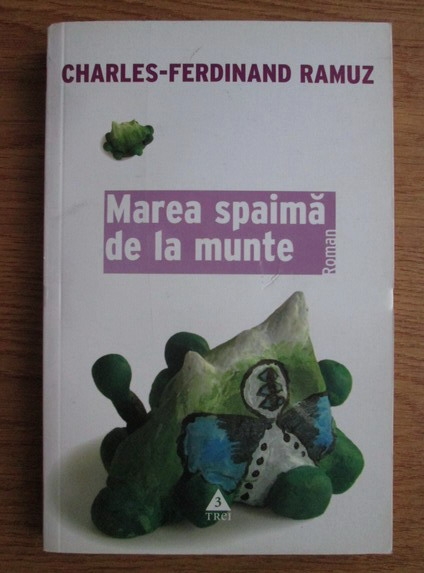
"Marea spaimă de la munte, unul din cele mai cunoscute romane ale lui C.F. Ramuz, este o capodoperă, o poveste despre iubire şi fatalitate, al cărei subiect se desfăşoară la mari înălţimi, într-un cadru de natură aspră şi sălbatică, ostilă omului şi lucrărilor sale, într-o atmosferă încărcată de spaime alimentate de credinţe şi reprezentări mitice. Se succed accelerat evenimente stranii, situate constant la limita dintre întâmplare şi irumperea unei forţe demonice în viaţa oamenilor, imagini de un dramatism halucinant, o compoziţie de o extremă fineţe şi un discurs de o insolită modernitate.
Celine spunea că dintre contemporanii săi nu vor mai fi citiţi în secolul XXI decât Ramuz, Morand şi el însuşi, într-atât era de îndrăgostit de limba autentică şi de originalitatea acestui scriitor elveţian de limbă franceză, Charles-Ferdinand Ramuz, despre care Stefan Zweig va zice că are „darul de a scoate la iveală deopotrivă sublimul simplităţii şi simplitatea sublimului"." (https://carturesti.ro/carte/marea-spaima-de-la-munte-62141#:~:text=Marea%20spaim%C4%83%20de%20la%20munte%2C,%C5%9Fi%20fatalitate%2C%20al%20c%C4%83rei%20subiect)"Charles-Ferdinand Ramuz (born Sept. 24, 1878, Cully, Switz.—died May 23, 1947, Pully, near Lausanne) was a Swiss novelist whose realistic, poetic, and somewhat allegorical stories of man against nature made him one of the most prominent French-Swiss writers of the 20th century.
A city boy, heir to a refined, middle-class culture, Ramuz nonetheless chose to write about rustic people in a language deliberately simple and earthy. Before World War I he spent a few years in Paris, associated with its painters and poets, and struck up a friendship with the composer Igor Stravinsky, for whom he wrote the text of Histoire du soldat (1918; The Soldier’s Tale). But he was untouched by Parisian literary fashions when he returned to Switzerland.
Ramuz wrote his best-remembered works between his 40th and 60th years. His representative theme is of mountaineers, farmers, or villagers fighting heroically but often tragically against catastrophe or the force of myth. In La Grande Peur dans la montagne (1925; Terror on the Mountain), young villagers challenge fate by grazing their cattle on a mountain pasture despite a curse that hangs over it; and the reader shares their panic and final despair. Among his other works are La Beauté sur la terre (1927; Beauty on Earth) and Derborence (1934; When the Mountain Fell)." (https://www.britannica.com/biography/Charles-Ferdinand-Ramuz)