
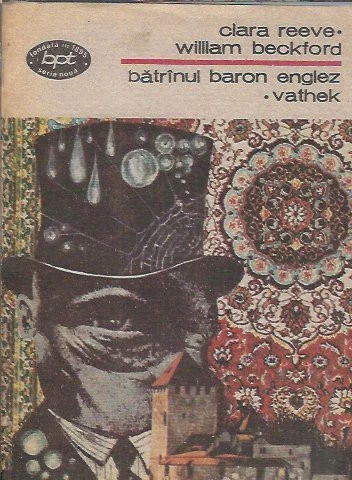
| Publisher: | Minerva |
| Genres: | Ficțiune, Autori străini |
| Authors: | Reeve Clara, Beckford William |
| Pages: | 294 pages |
| Binding: | Necartonată |
| Edition: | 1 |
| Language: | Română |
| Physical Form: | Book |
| Size: | Mică |
| Type: | Standard |
| Store: | Liceu si gimnaziu |
| Number of copies: | 1 |
"Clara Reeve (1729-1807) was an English writer. She was born in Ipswich and was educated, as she wrote in a letter to a friend, mainly by her father. After the death of her father she started writing and translating. Her novels include The old English baron (1777), after the example of Horace Walpole’s The Castle of Otranto, and the epistolary novel The school for widows (1791). She also wrote a history of prose fiction titled The progress of romance (1785). This work is supplemented by the Oriental tale ‘The history of Charoba, queen of Egypt’." (https://www.kent.ac.uk/ewto/projects/anthology/reeve.html)
https://lib.guides.umd.edu/gothicliterature/ReeveandWalpole
"William Beckford was a prominent English writer and art collector, best known for his literary work and extravagant architectural projects. Born into wealth, he inherited his father's fortune at a young age and was educated by notable figures, including composer Wolfgang Amadeus Mozart. Beckford's literary reputation is largely anchored in his novel "Vathek," which stands out as an unusual work in English literature because it was originally written in French. The book narrates the fantastical and often dark adventures of an Arabian caliph, showcasing Beckford's imaginative storytelling.
In addition to "Vathek," Beckford authored several other works, often under pseudonyms, and contributed to the literary scene with titles that reflected his unique perspective. He was also known for his impressive constructions, including Fonthill Abbey, which took eighteen years to complete and was considered a monumental achievement of its time. Despite his wealth and creative successes, Beckford's later years were marked by a desire for nobility that he struggled to attain. His life and works encapsulate a blend of literary talent and ambitious artistic vision, making him a significant figure in English cultural history." (https://www.ebsco.com/research-starters/history/william-beckford)
William Thomas Beckford (1760-1844) was an English nobleman, traveller and writer who wrote mainly in French. Beckford was born in London and at an early age inherited a huge fortune and the Fonthill estate in Wiltshire, England, apart from several sugar plantations in Jamaica. After gaining a reputation of sexual aberrancy he chose to live in exile and spent a large part of his life travelling through France, Spain, Portugal, Italy and Switzerland. From his early life he developed a special fascination for Arabic culture. In the 1790s he embarked upon the large building project of Fonthill Abbey, a rather monstrous orientalist construction, which was never completed and which was the venue of several extravagant festivities. It also housed Beckford’s large collection of art. In 1822 and 1823 Fonthill and part of the art collection were sold to pay for Beckford’s high debts. As an author, Beckford is known for his travel letters and, especially, his short novel Vathek (1786), which gained a cult-status and is seen as an important example of Gothic literature, influencing the poets and writers of 19th century Romanticism. He also wrote Épisodes, a collection of Oriental tales inspired by the Thousand and one nights which he intended to include in Vathek.
From his early youth Beckford was fascinated by the Thousand and one nights, and his literary pursuits can be seen as a prolonged effort to evoke the spirit and atmosphere of the exotic, magical, realm of the Nights. For his own work he utilized not only his own experiences and fantasies, but also the well-known Bibliothèque orientale, an extensive and widely used reference work about the Orient, compiled by Barthélemy d’Herbelot and edited by Galland (1697). According to Beckford, the novel Vathek (1786) was written in one session during three days and two nights, in one outburst of his imagination. It was written in French, but published first anonymously in the English translation of his friend Samuel Henley, without Beckford’s consent. A French version followed in the same year. The story is an eccentric fantasy about the Caliph Vathek who organizes a huge, almost apocalyptic banquet. He builds five huge palaces, each devoted to one of the five senses. In his hubris, Vathek makes a Faustian pact with a stranger named Giaour, and departs to the ruined town of Istakar. His mother, meanwhile, is occupied with all kinds of macabre and occult rites. The book is full of grandiose visions, occult speculations and exotic sensuality and cruelty. The novel remains a small monument in the tradition of Gothic and fantastic literature, representing the darker side of Romanticism and conveying the atmosphere of repressed desires, fears and nightmares. The novel appeared without a number of stories which Beckford intended to insert in the main story. These appeared as late as 1909 under the title Épisodes, in which the atmosphere of Vathek is further explored and connected with Beckford’s doubts about his sexuality (‘Histoire du prince Alasi et de la princesse Firouzkah’). Furthermore, Beckford adapted some stories from the Wortley-Montague manuscript which was in his possession at the time (now in the Bodleian Library), and collected them in Suite de contes arabes (1770s-1780s). The story of Histoire du Prince Ahmed stages a young, lazy adolescent who is sent out into the world by his father and wanders through enchanted landscapes, full of palaces with young maidens, strange figures, deserts. He traverses the Plaine des Ginns, which is full of skeletons, with his friend Prince Ahmed, haunted by the curse of the children of Zouc Zouc. The prince tells the story of his love for Princess Neubahar. The story is a typical example of exotic orientalism, with enchantments, sublime landscapes, strange encounters, sensuality, (homo-)eroticism, travesty, seduction, etc., systematically referring to the realm of the Thousand and one nights. (https://www.kent.ac.uk/ewto/projects/anthology/william-thomas-beckford.html)